
The Head of the Charles, From the Beef Country Side of the River
Every October the Head of the Charles Regatta (HOCR), one of the world’s biggest rowing weekends, takes over the river at the bottom of Beef Country. Here’s how to watch it, which bridges cause trouble, and what an eight-oared racing boat has in common with a Three-Way.

In October 2006, a racing eight from Peking University began to sink in the middle of the Charles River. It had bumped another boat near the Weeks Footbridge, a tap its coxswain thought nothing of. A mile later, at the last bridge on the course, the bow was underwater and the rowers were going over the side.
The coxswain didn’t follow them. Amy Sun was an MIT coxswain and regatta volunteer, drafted when the Chinese crew arrived without one of its own. As the boat went under, she stood up in her seat. She was wearing yellow, and she figured the crews coming around the turn would see that before they saw a swamped hull. She stayed standing until the traffic thinned and a launch came to pick her up.
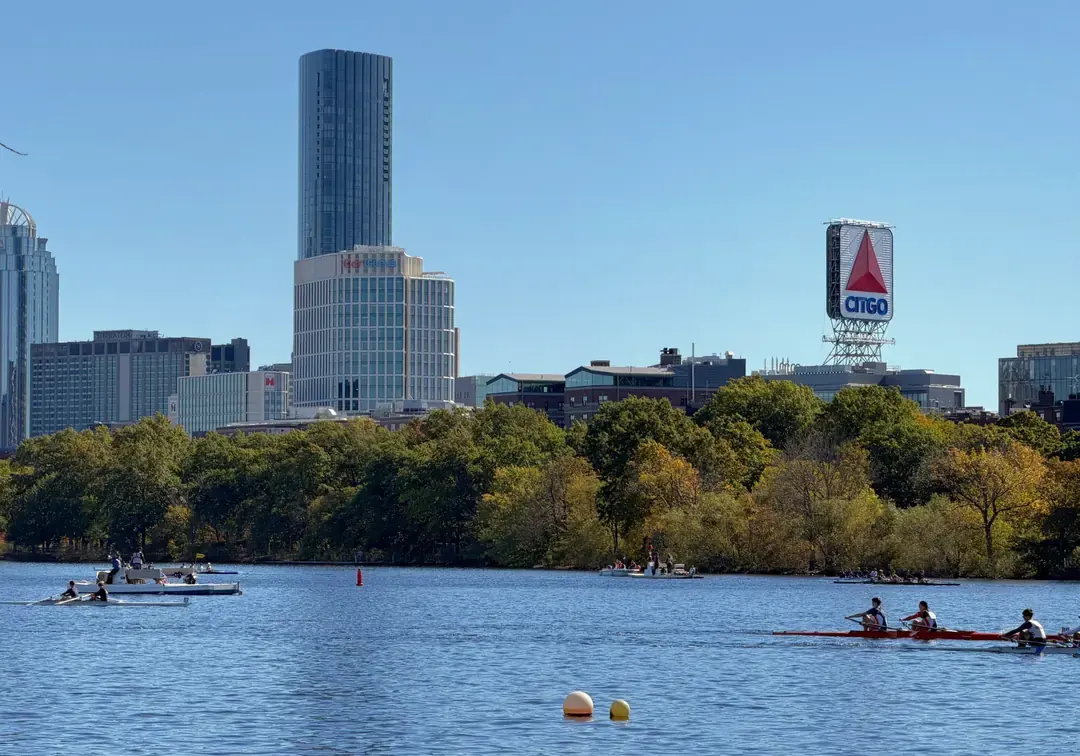
The Head of the Charles Regatta asks a lot of one river. In 2026 it billed itself as the largest three-day regatta in the world, and nearly 12,000 rowers came to race. Each fall it sends more boats through nearly three miles of bends and bridges than the Charles can comfortably hold, and it counts on people like Sun to keep their heads.
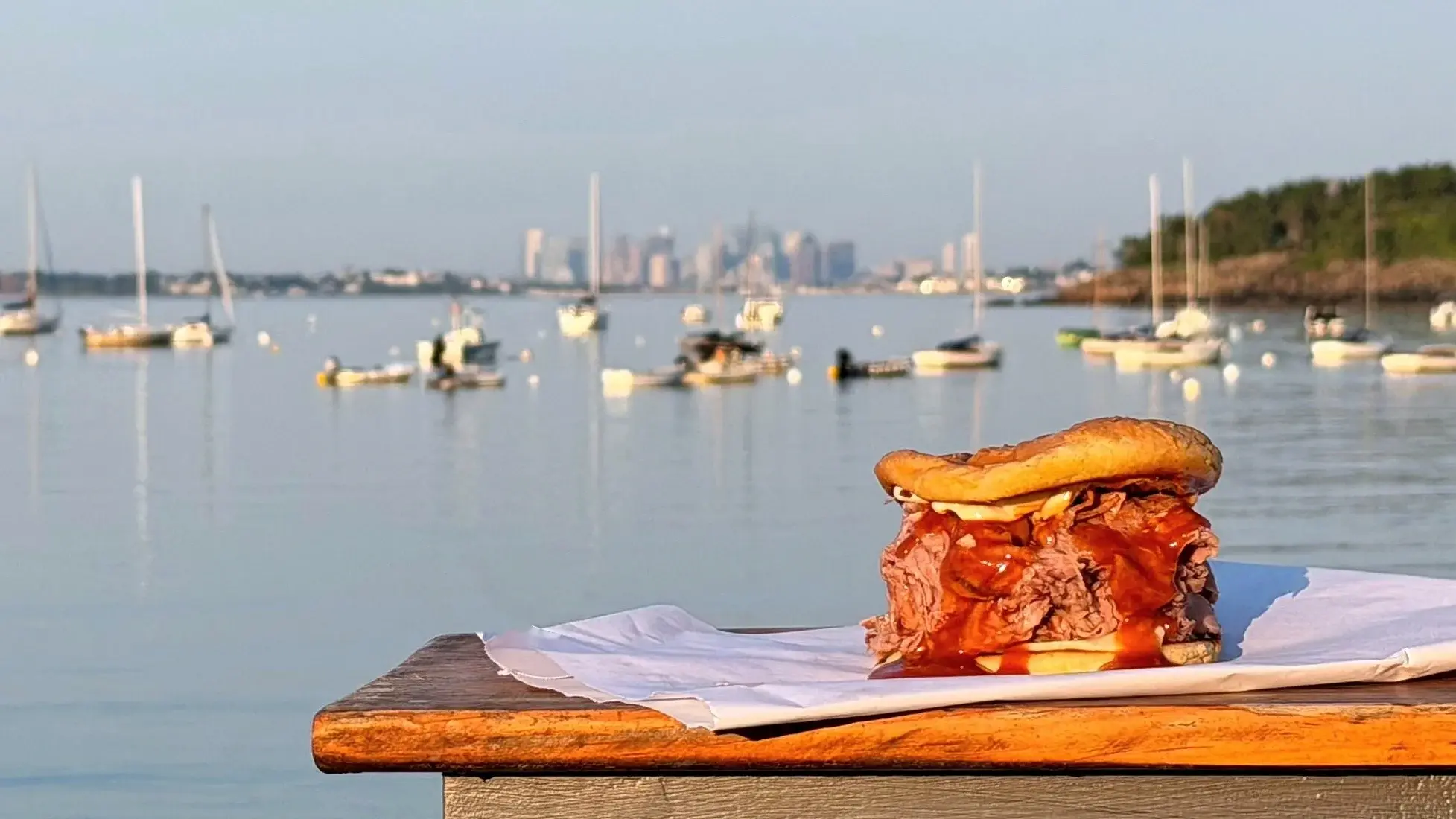
The Charles is the southern edge of Beef Country. Cambridge is in, Boston isn’t. For anyone who hasn’t had one, a Beef is rare roast beef, sliced so thin it ribbons and piled hot on a toasted, buttered roll. A Three-Way adds extra-heavy mayo, James River BBQ sauce, and white American cheese.
A race nobody expected to last
In the mid-1960s, three members of the Cambridge Boat Club wanted something to break up the grind of fall training. They went to Ernest Arlett, an Englishman who coached rowing at Harvard, and he suggested the kind of race he’d known at home. In a “head of the river” race, boats start one at a time and race the clock instead of each other.
The first race was held on October 16, 1965. D’Arcy MacMahon, one of the founders, told the Boston Globe that the medals seemed “extraordinarily fancy for a regatta that might not even have a second year.”
But MacMahon wrote up the race for the national rowing association, and in his report “countless thousands lined the shores.” He later said it was a joke, because hardly anyone had come. The line was taken literally, and the following October a real crowd turned up.
The crowds kept coming, and by the mid-1980s they had grown rowdy enough that spectators on the Eliot Bridge were lowering cases of beer to crews that had just finished. In 1987 alcohol, open fires, and overnight camping were banned along the banks.
Behind the scenes, the regatta stayed a part-time operation for years. The founders all had day jobs, so anyone who phoned the boat club with a question was referred to Charles Attager, who was never in because he didn’t exist. His last name is “regatta” spelled backward, and the regatta’s awards tent is called Attager Row. Someone finally came to the phone in 1991, when the organizers hired their first full-time employee, an executive director.
Volunteers still do most of the work, about 2,400 of them by the regatta’s count, and the heavy lifting goes to Gentle Giant, a Somerville moving company founded by a rower, Larry O’Toole. The company even has its own rowing club, whose summer race for beginners pays out a fresh pineapple for first place, dried pineapple for second, and a can for third.
In 1996 a storm dropped 5.66 inches of rain on Cambridge, with gusts of 50 mph, and the race was canceled for the first time. The next year the organizers spread the racing over two days, partly as insurance against the weather. The race was called off once more, in 2020, for the pandemic, and it came back in 2021 as a three-day race.
How the Head of the Charles works
At the Olympics, six boats line up side by side and race to the line. Here the crews go off about 15 seconds apart, and the fastest time over the course wins. With the boats strung out along the river, spectators on the bank don’t know who’s won until the times are posted.
On a straight river that would be simple, but the Charles bends its way through 4,702 meters, a little under three miles, and under seven bridges. Because the faster crews keep catching the slower ones, much of the racing comes down to who gets through a bridge first. The slower crew is supposed to move over, and the officials add a minute when it doesn’t.
That’s why rowers call this a coxswain’s race. Everyone else in the boat sits facing backward, so the coxswain (pronounced “COX-un”) steers, calls the moves, and is the only one aboard who can see where the boat is going. Going into a bridge, the coxswain of the faster boat tells the slower one which way to move, often by its bow number (“Bow 112, move to starboard!”), and the coxswain being passed is usually sure the other boat is in the wrong.
Asked what makes the Head hard, a college coxswain didn’t hesitate. “It’s the bridges,” he told the Hub. “Weeks, Anderson, Eliot.”
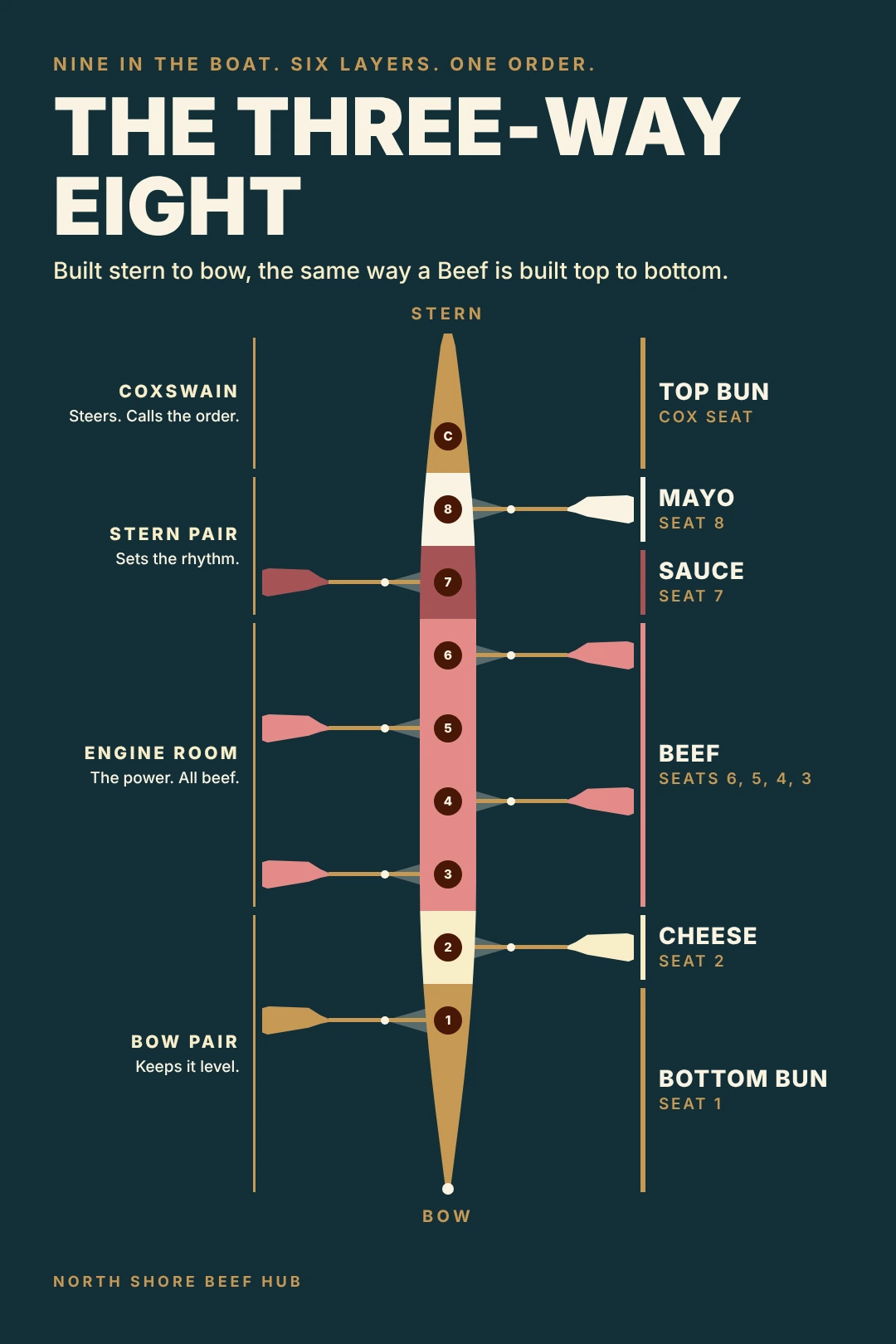
An eight is built like a Three-Way
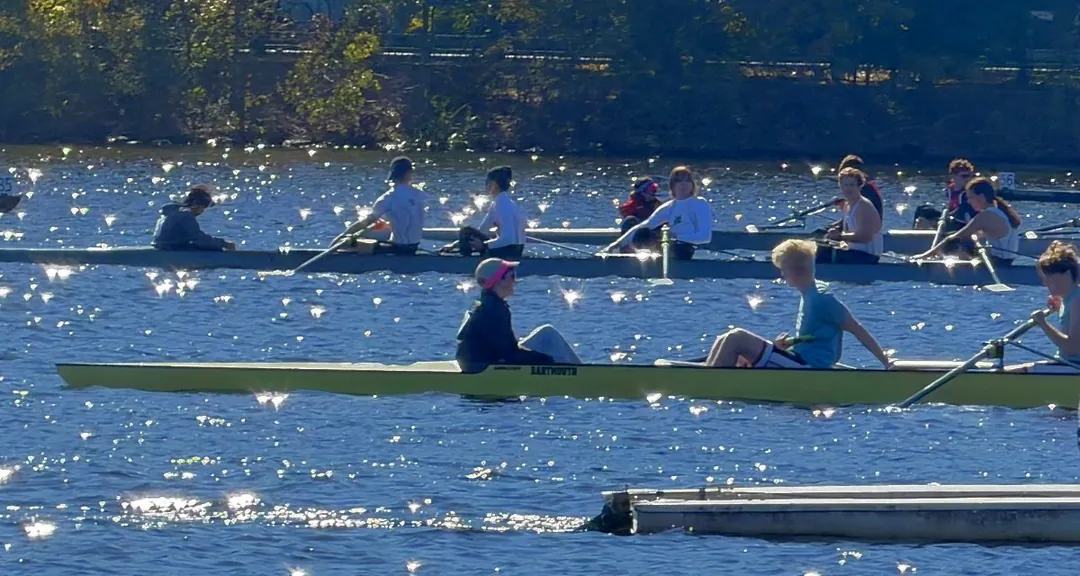
The boat most people come to see is the eight, a hull about 60 feet long and barely wider than the people sitting in it. Rowers call it a shell, and in 2026 a new one started at about $45,000. In some boats each rower handles two oars, but in an eight every rower pulls a single oar with both hands. Beef Country will understand the arrangement, since any Beef takes two hands.
The front of the boat is the bow and the back is the stern, and rowers think of the seats between them in three sections.
- Stern pair (seats 8 and 7): They set the rhythm, and the rest of the boat follows it.
- Engine room (seats 6, 5, 4, 3): The biggest and strongest rowers, who supply most of the power.
- Bow pair (seats 2 and 1): Lighter, steadier rowers who keep the boat level.
The ninth seat belongs to the coxswain, whose job is to take the blame at the bridges.
A Three-Way is built the same way, top to bottom. The top bun sits where the coxswain does, on top of everything and in charge of holding it together. The mayo and the James River are the stern pair, the first thing anyone tastes, and they set the tone for every bite that follows. The beef is the engine room, piled thick in the middle, and it’s the reason anyone orders a Beef. The white American and the bottom bun are the bow pair, keeping it level so nothing slides out the bottom. Change the order and it’s a different sandwich, and a crew that seats its bow pair in the engine room gets a slower boat.
Seven bridges, and everybody’s got a favorite
The crews race upstream from Boston University’s boathouse to Herter Park. Beef Country has more than 150 Beef shops to argue over and the course has only seven bridges, but the argument goes the same way. Once people pick one, nobody can talk them out of it.
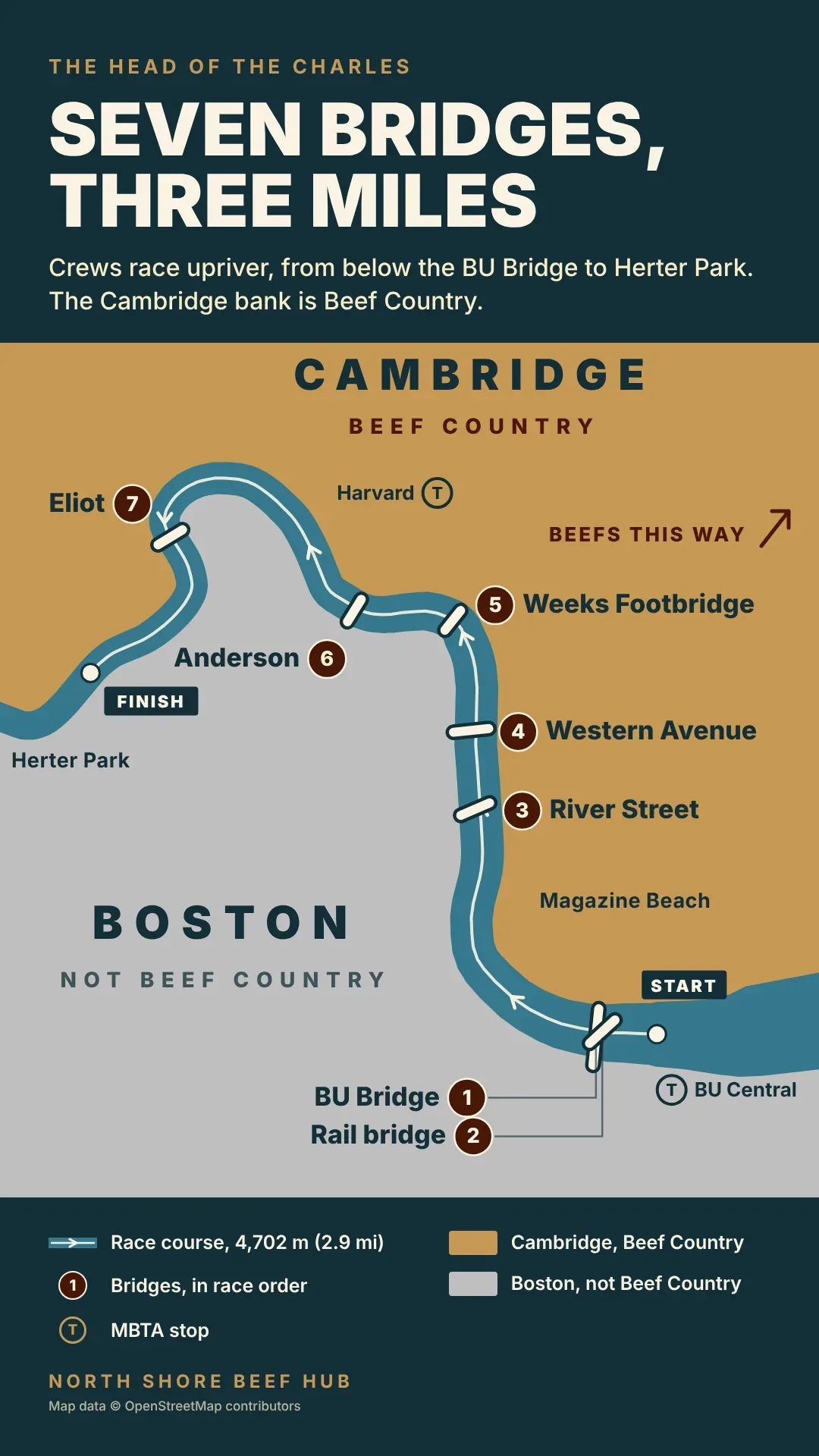
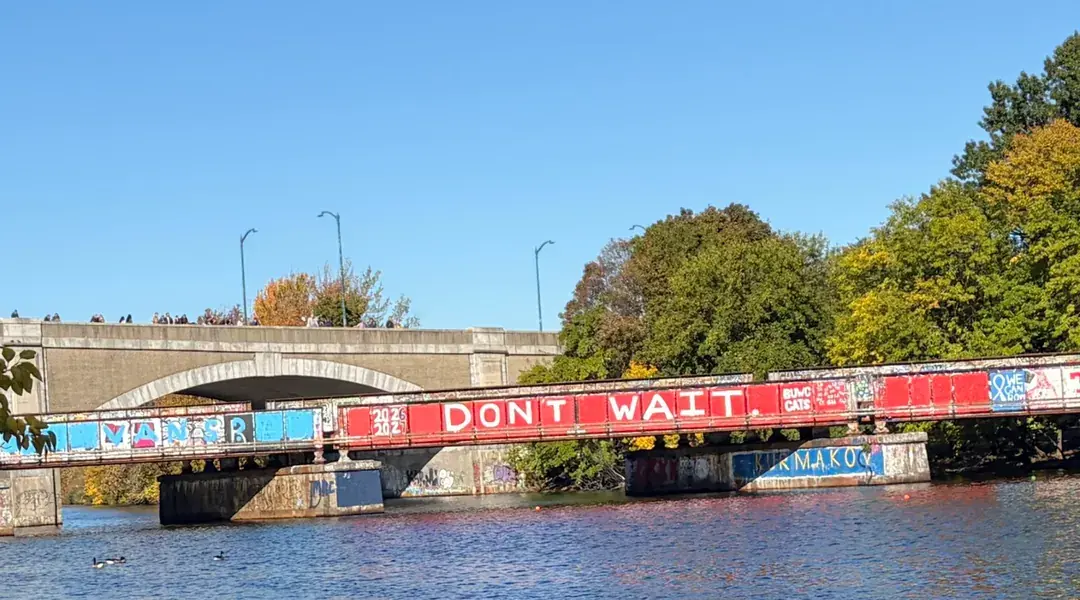
The BU Bridge comes first and is the strangest. It counts as two of the seven, a road bridge with a rail bridge slanting underneath it, which is why some guides say the course has six. It’s also one of the few places on earth where a rower can pass under a train that’s passing under a car that’s passing under a plane.
The red-and-white message on the rail bridge gets a new slogan every year, painted the night before racing starts. Crews see it on their way down to the start, and it’s the last thing they read before they turn around to race. Nobody takes official credit, though Boston University’s own news site once passed along a rumor that its freshman women rowers do the painting.
River Street and Western Avenue sit on the Powerhouse Stretch, the long straightaway in the middle of the course.
Weeks Footbridge is the crowd favorite. It’s a footbridge, so spectators can pack the whole span, and it sits right over a bend of nearly 90 degrees. An eight doesn’t corner like a car, and everyone on the bridge gets to watch it try.
Anderson Bridge, beside Harvard’s Weld Boathouse, comes about a quarter mile after Weeks.
Eliot Bridge, the last one, sits at the end of the longest turn on the course, with the finish still ahead and everyone’s legs already spent. In 1999 a girls’ crew from Boone High School in Orlando hooked a course buoy on the way in and dragged it, cable and all, to the finish. Rowers call an oar stuck in the water a crab, and the crew’s coach called this one a crab trap. In 2026, with repairs underway, crews had a single racing arch to aim for.
The finish line is at Herter Park, on the Boston side. The medal hasn’t changed since sculptor Joe Brown designed it for 1965.
Who races the Head of the Charles
Olympic champions race here, and so do high school crews and rowers past 90, though the field wasn’t always that open. In 1969 an economics professor named Gail Pierson entered the novice singles, a race for one-person boats, and became the first woman to race the Head, according to the Harvard Crimson. As she put it later, “nobody said I couldn’t enter.” She finished ahead of about half a dozen men, and the regatta soon gave women a singles title of their own, which Pierson won every year through 1974.
Age hasn’t kept anyone off the river either. In 2024 the singles added a medal for rowers past 90, and it went to Kit Collins of Virginia, who was 92 and hadn’t taken up rowing until he was 66. Two years later, eight women from Marin County, ages 77 to 85, raced in the over-80 category, a first for an all-women’s eight, according to local news. They finished in just over 27 minutes, and most of them hadn’t picked up an oar until their 50s.
The other end of the age range belongs to the high schools, whose events have drawn about 90 crews apiece in recent years. Beef Country sends its share, with crews from Cambridge, Belmont, Arlington, Danvers, and Andover in 2023 and 2024. The Phillips Academy boys crossed the line 34th in 2024, then took a one-minute penalty for not yielding under a bridge and dropped to 71st. Sometimes the other boat is right, though not everyone on the crew saw it that way. “Everybody on the team knows in their hearts that we placed 34th, truly,” one of them told the school paper.
What it takes to feed an eight
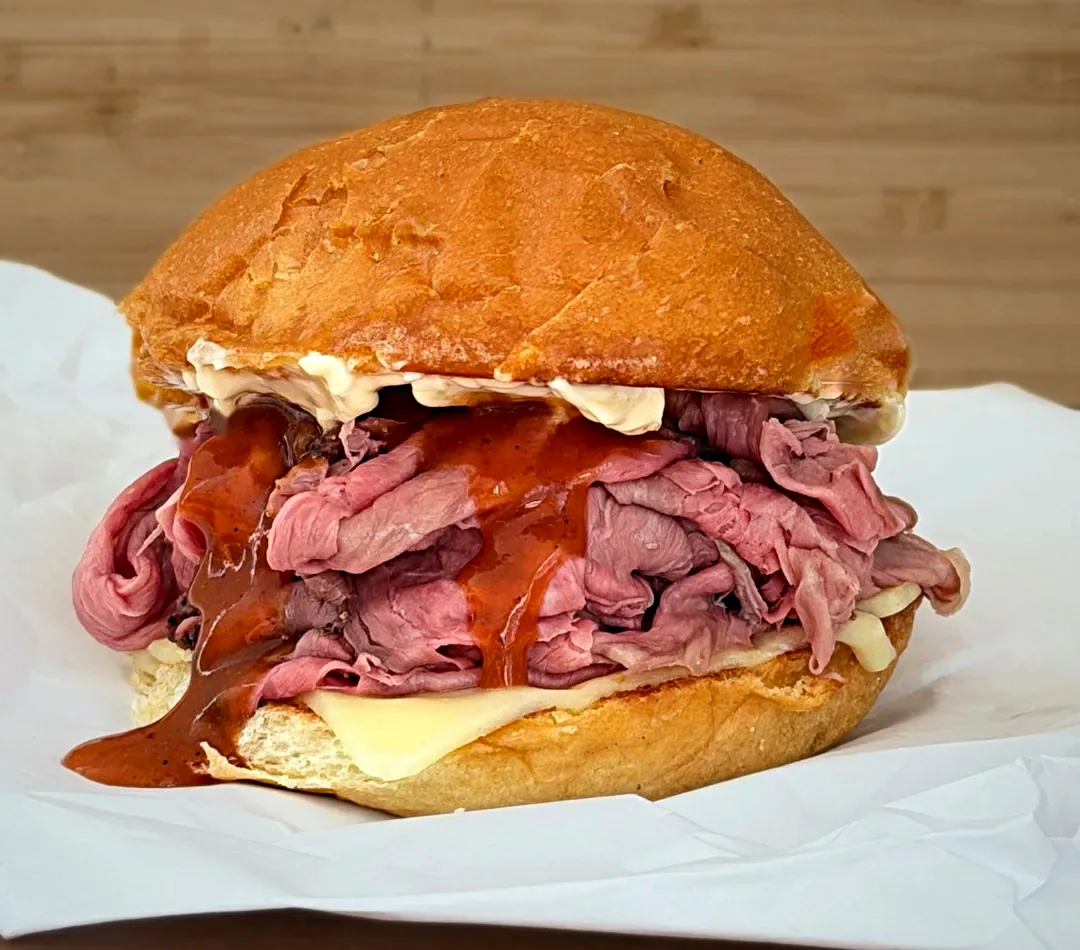
A 2022 study in Frontiers in Physiology found that elite male rowers in a heavy training week need about 6,775 calories a day, roughly three times what most adults eat. No shop posts the numbers, but by the Hub’s rough count a Super Three-Way comes to about 1,200 calories, which works out to five or six Supers per rower and about 45 for the whole eight. The coxswain, who got them through all seven bridges, gets one too.
A Super Three-Way before a race is a bad idea, and most rowers stick to whatever they always eat. Afterward is another story. A college rower told the Hub he could put away at least two Supers.
In 2026 the regatta lined the course with about two dozen food vendors, and not one was a Beef shop. The nearest Beefs are on the Cambridge side of the river. Cambridge and Somerville both have Beef shops within about two miles of the course, and there are more a few miles north in Medford and Everett.
The Hub doesn’t pick favorites, though it will point out that anyone who’s just raced nearly three miles upstream has earned a Super.
If you go
When: Since 2021 the regatta has been held Friday through Sunday on a weekend in the second half of October. In 2026 racing started before 8 a.m. each day, and the championship eights, the fastest boats on the river, went off on Sunday afternoon. Each year’s dates and schedule are at hocr.org.
Cost: Watching is free from the bridges and the public stretches of riverbank. Only the hospitality enclosures are ticketed.
Getting there: Take the T. The Red Line to Harvard and the Green Line B branch to BU Central will each leave you a short walk from the river. Check the MBTA for weekend service changes.
Crowds: The bridges fill up and the stretches between them don’t. The crowd, about 325,000 in recent years, is spread over three days and two riverbanks, and anyone who’s parked in Salem in October has seen worse. At Herter Park, where crews carry their boats out of the water after the finish, give them plenty of room. They’re carrying 60 feet of boat that can cost as much as a new car, and they can’t see around it.
Where to watch the Head of the Charles
- Close calls: Weeks Footbridge or Eliot Bridge
- Room to breathe: Magazine Beach
- Food: The vendor map at hocr.org
- Finishes and medals: Herter Park
- A Beef afterward: Cambridge and Somerville
Want to try it yourself? Rowing clubs on the Charles and the Mystic teach beginners every summer, from middle schoolers to retirees. Kit Collins didn’t start until he was 66, and at 92 he won a medal at the Head.

The ninth seat belongs to the coxswain, whose job is to take the blame at the bridges.
Common questions about the Head of the Charles
What is the Head of the Charles Regatta?
The Head of the Charles Regatta is a three-day rowing regatta on the Charles River between Boston and Cambridge, held Friday through Sunday on one weekend in the second half of October. It’s a head race, which means crews start about 15 seconds apart and the fastest time over the course wins.
Is the Head of the Charles free to watch?
Yes. Watching from the bridges and the public stretches of riverbank is free. Only the hospitality enclosures are ticketed.
How long is the Head of the Charles course?
The course is 4,702 meters, a little under three miles. Crews race upstream from Boston University’s boathouse to Herter Park and pass under seven bridges.
Where is the best place to watch the Head of the Charles?
The Weeks Footbridge and the Eliot Bridge have the closest racing, Magazine Beach has the most room, and Herter Park on the Boston side has the finish line.
Where can I eat near the Head of the Charles?
The regatta sets up food vendors along the course. The nearest Beef shops are on the Cambridge side of the river, in Cambridge and Somerville, within about two miles of the course.
What is a coxswain?
The coxswain, pronounced “COX-un,” sits in the back of the boat, steers, and calls the moves. The rowers face backward, so the coxswain is the only one aboard who can see where the boat is going.
What is a Beef?
A Beef is a North Shore roast beef sandwich: rare roast beef, sliced so thin it ribbons and piled hot on a toasted, buttered roll. A Three-Way adds extra-heavy mayo, James River BBQ sauce, and white American cheese.
What is Beef Country?
Beef Country is the North Shore Beef Hub’s map of 66 towns and more than 150 Beef shops north of Boston. It has five regions: Greater Boston, the North Shore, Cape Ann, the Seacoast, and the Merrimack Valley.