
The South Shore Never Got a Beef
The North Shore and South Shore sit on opposite sides of Boston, but they might as well be different states. Here’s how their food, beaches, culture, and loyalties diverged. Only one shore got the Beef, and the other one needs a sandwich.
Tunnels, bridges, and highways connect them. You'd think the North Shore and South Shore would have plenty in common.
They share the same brutal Boston commute, the same nor’easters, the same dropped R’s, the same four teams. They both say wicked, frappe, and clicker. Both are sure they alone know how to take a rotary.
Neighbors this alike are supposed to be rivals.
They aren’t. Not really.
Bring up the other shore to a lifer, and you may get a blank look. Put that same lifer on the other side of Boston, though, and they’ll know something is off, even if they can’t quite say what.
The Pilgrims founded Plymouth Colony in 1620; Puritan settlers arrived in Salem a few years later. The North Shore runs from Boston northeast through Cape Ann and toward the New Hampshire border, while the South Shore extends from Boston through Quincy, Hingham, Scituate, and Plymouth.
The South Shore is Boston’s Irish coast, its shoreline long nicknamed the Irish Riviera. Scituate has been called the most Irish town in America, with roughly 40 percent of residents claiming Irish ancestry. It briefly lost the distinction to nearby Hanover, then took it right back. The Dropkick Murphys got their start in Quincy, which feels about right.
On the North Shore, it comes down to a sandwich.
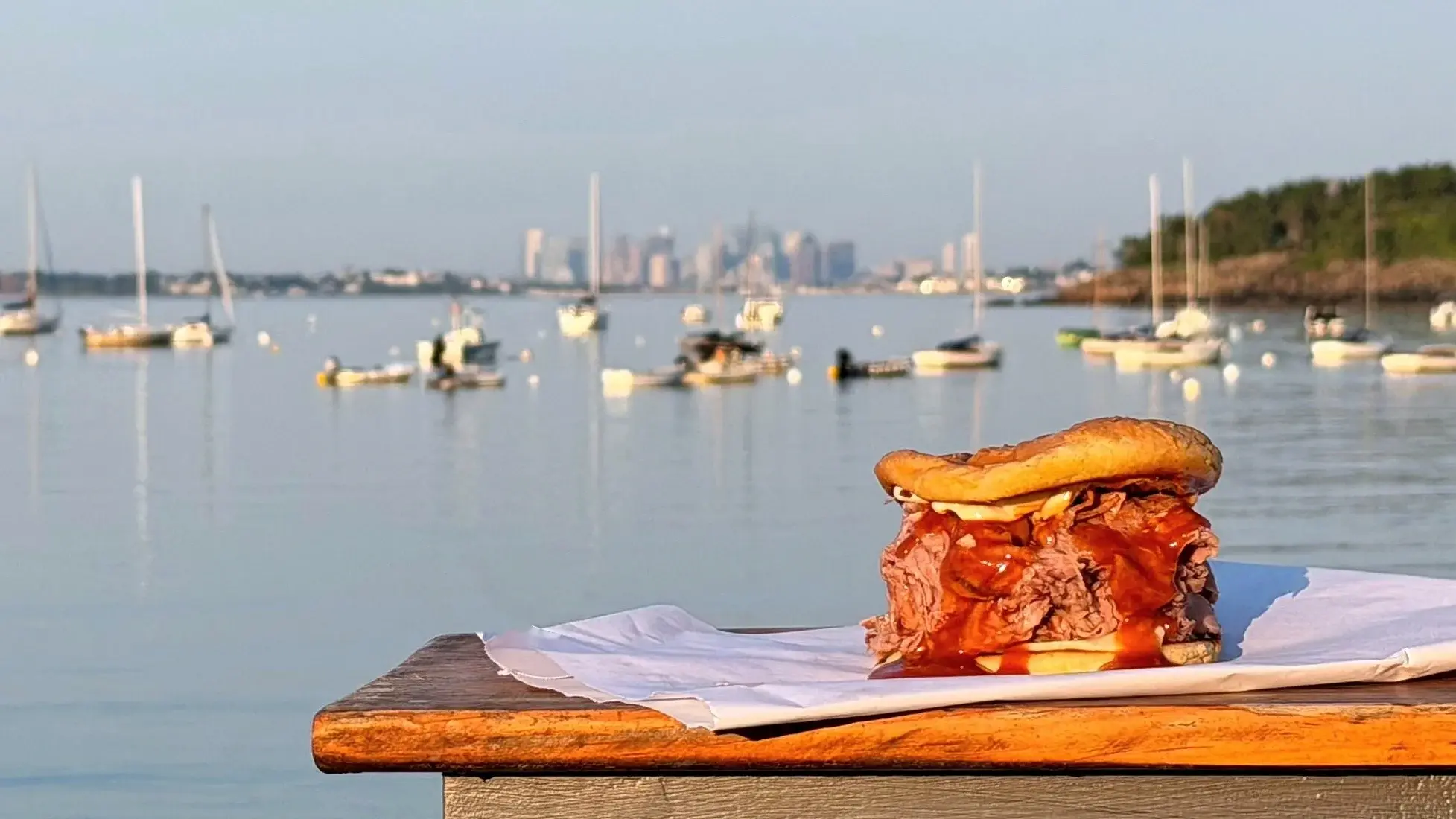
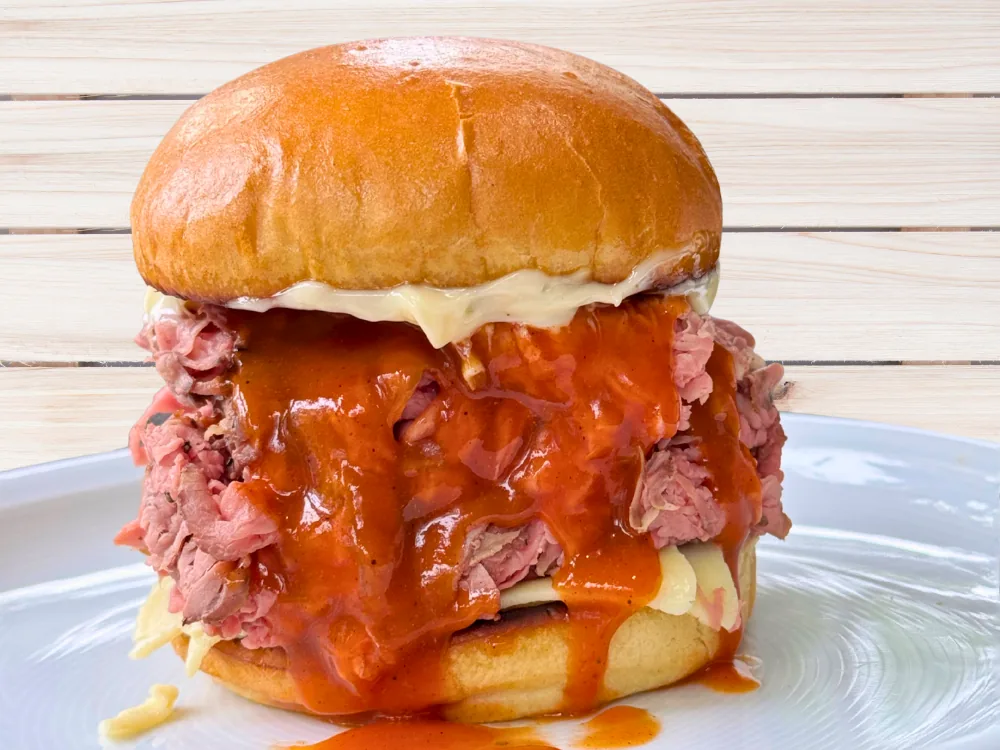
For roughly 75 years, the region has been obsessed with roast beef, the local specialty called a Beef. Order one, and you get rare beef, sliced so thin it ribbons, piled hot and pink on a toasted, buttered roll. Make it a Three-Way, and it comes with extra-heavy mayo, James River BBQ sauce, and white American cheese. Cold or gray or well-done, and it isn’t a Beef.
You order at a counter. There’s a Junior, a Regular, and one big enough that it often comes on an onion roll. Any of them takes two hands.
More than 150 shops make Beefs north of Boston, across a region we call Beef Country.

This isn’t roast beef in the deli case. A Beef comes out warm, the sauce running down your wrist, gone before you’ve merged back onto Route 1.
The South Shore, for the most part, has no idea what we’re talking about.
The same split runs through everything else: the movies, the art, the history, the giant restaurants, even the beaches.
We’ll take it one category at a time, then come back to the sandwich the South Shore never got around to inventing.
The movies
Hollywood keeps coming back to the North Shore, and Cape Ann does most of the work. Sometimes it plays itself. CODA, filmed in Gloucester and Rockport, won Best Picture in 2022, the first film released by a streaming service to take the top prize. The Perfect Storm sent the Andrea Gail out of Gloucester Harbor.
Sometimes it plays somewhere else. Rockport played Alaska in The Proposal. The lawns below Castle Hill in Ipswich played Paris in Little Women.
Adam Sandler grew up over the border in New Hampshire, but he keeps turning up in Marblehead. He made it his character’s hometown in Grown Ups 2, then dressed the town for Hubie Halloween. Marblehead claims him anyway.
The South Shore gets its close-up, too. The Departed filmed its warehouse shootout at the old Fore River Shipyard in Quincy. American Fiction filmed in Scituate.
Every so often, a movie needs both shores. The Witches of Eastwick turned Cohasset into its fictional town, then drove north to use Marblehead’s Abbot Hall for the concert scene.
It took both shores to build one town that doesn't exist.
The art
One shore got painted. The other did the writing.
Painters have been chasing the North Shore’s light for nearly two centuries. Fitz Henry Lane was painting Gloucester Harbor in the 1840s, finding drama in still water, working boats, and the last light of day. Winslow Homer, Edward Hopper, and Stuart Davis followed, each finding something different in the same harbors and streets.
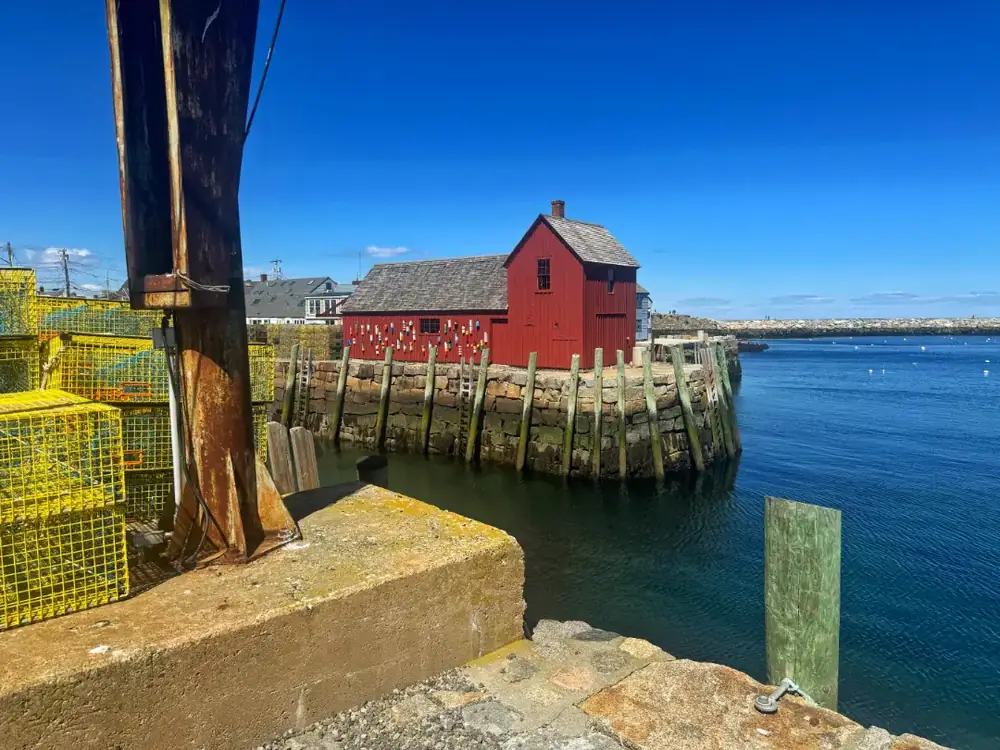
The painters never really left. Gloucester’s Rocky Neck calls itself one of the country’s oldest continuously operating art colonies. Across the water in Rockport, the red fishing shack known as Motif No. 1 has been painted so many times that it may be more famous on canvas than it is on Bradley Wharf. Here’s the part nobody puts on the canvas: the building everyone paints isn’t the original. That one washed into the harbor in the Blizzard of ‘78, and Rockport rebuilt it that same year, board for board, buoys and all.
John Cheever grew up in Quincy and won a Pulitzer. In one story, a man swims home through his neighbors’ pools. Brockton native George V. Higgins became a federal prosecutor and spent years listening to cops, lawyers, and criminals talk. The Friends of Eddie Coyle consists almost entirely of dialogue. Boston crime writing has sounded like it ever since.
The history
Plymouth owns the country’s best-known origin story, with the Rock to prove it.
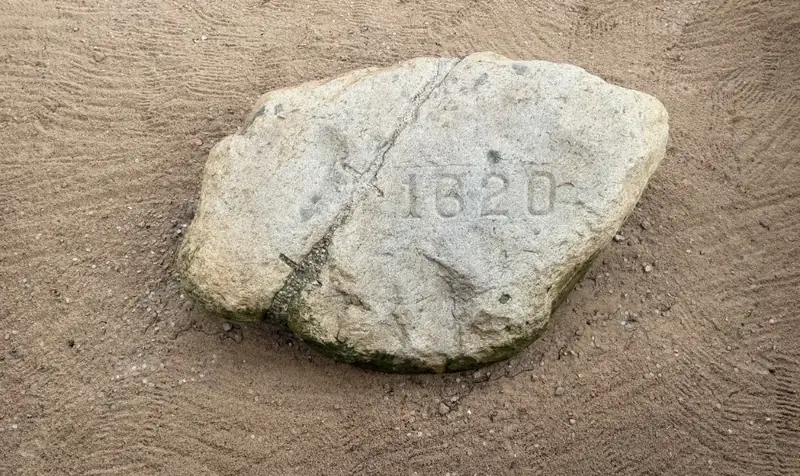
Plymouth Rock is also one of America’s most reliable letdown landmarks. It’s considerably smaller than it once was, chipped away by souvenir hunters and cracked in two in 1774 when a team of oxen tried to haul it into the town square. Today, visitors reach the boulder marked 1620 and ask, “That’s it?” Some locals call it the Plymouth Pebble.
Quincy produced two presidents, John Adams and John Quincy Adams.
For generations of Massachusetts kids, Plymouth has also meant a field trip to Plimoth Patuxet, and a November spent tracing a hand onto construction paper and calling it a turkey.
The North Shore counters with Salem, where 19 people were hanged during the witch trials in 1692. The last conviction wasn’t cleared until 2022, after an eighth-grade civics class in North Andover took up the case.
Remarkable history. Just not the founding story.
The giant restaurant
Each shore has had its enormous restaurant, the kind the family piles into for a graduation, somebody’s 90th birthday, or a First Communion. You went at least once, or you know someone who won’t stop talking about it.
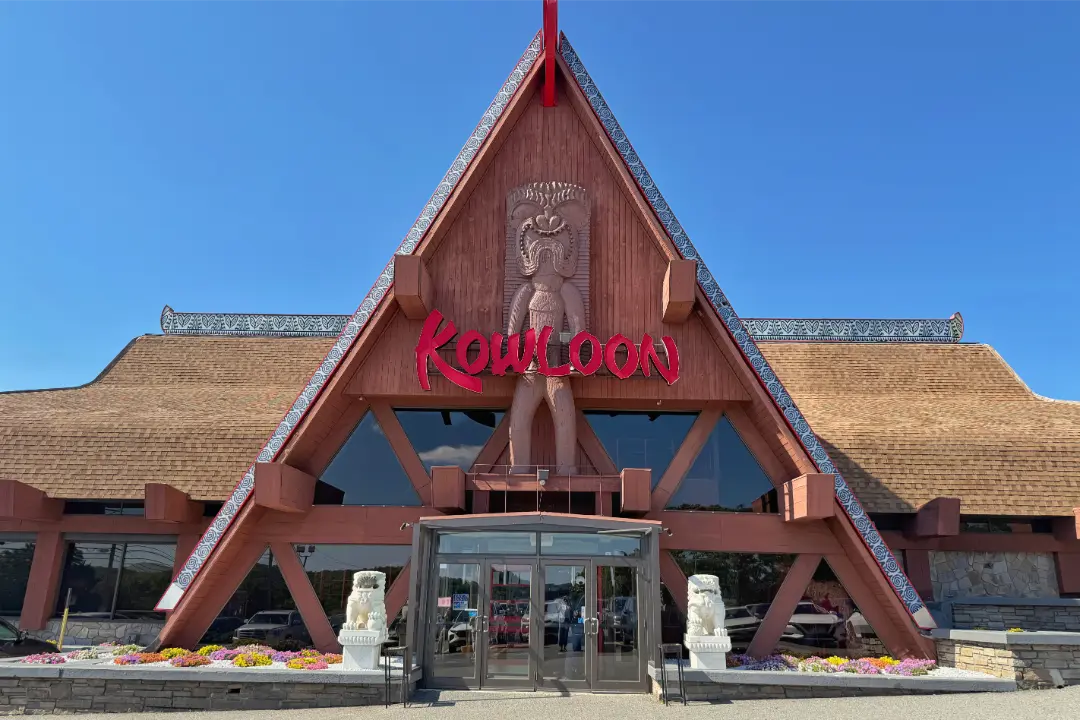
On the North Shore, it’s Kowloon, on Route 1 in Saugus since 1950 and run by the Wong family since 1958. The enormous A-frame gives it away from the road: a tiki carved into the peak, KOWLOON spelled in red script, stone foo dogs guarding the entrance. Inside are 1,200 seats, faux volcanoes, and Scorpion Bowls built for a whole table.
Kowloon may not always be this big. Redevelopment plans would replace the Route 1 landmark in stages with apartments and a much smaller restaurant. No date has been set. The Wongs have already carried the tiki to Kowloon Tiki on the Beach in Revere, along the same stretch of shoreline where the Beef took hold in 1951.
On the South Shore, it was Christo’s, a Brockton landmark with color-coded dining rooms, the grandest of them the Gold Room. Gov. Michael Dukakis, a friend of founder Christos Tsaganis, dubbed him the Greek Salad King after seeing the size of Christo’s signature salad. Christo’s served its last meal on New Year’s Eve 2013.
The beaches
The North Shore looks rocky. Then you hit the beach.
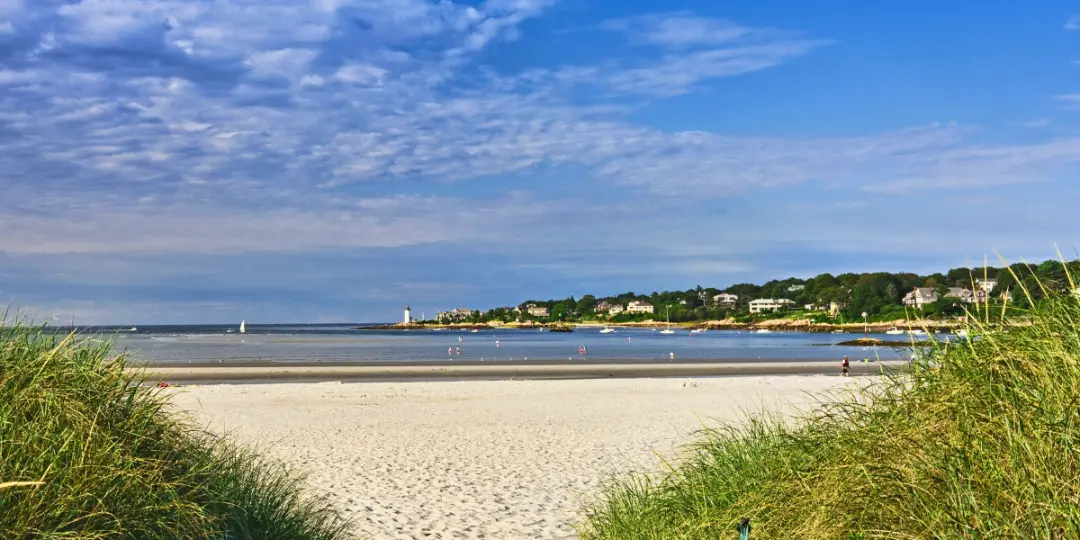
Crane Beach in Ipswich runs for miles beneath Castle Hill. Singing Beach in Manchester-by-the-Sea gets its name from the squeak of sand underfoot. At low tide, Wingaersheek’s sandbar carries you toward Annisquam Light. At each one, a Beef is a short drive from the sand.
For a few weeks in midsummer, the greenheads take the beaches back. The biting flies come out of the marshes thick enough to empty the beach until the calendar turns. One summer, somebody drew two skeletons in Sharpie on a greenhead warning sign at the Parker River gatehouse on Plum Island: the ones who didn’t make it out.
South of Boston, the beach has always been part of summer. Nantasket in Hull has been drawing crowds from the city since the 1800s, and Paragon Park’s rides rose above the sand from 1905 to 1984. The park is gone, but its carousel still turns.
Farther south, the wooden Powder Point Bridge crosses to Duxbury Beach, six miles of barrier sand. You can drive on it with a permit when the plovers allow it.
The capes are the other split. Cape Cod starts past the canal, which puts it outside the South Shore. Getting there in July means driving through the South Shore, hitting backups at the Sagamore or Bourne Bridge, and then fighting for parking. Cape Ann is straight up Route 128, and on a weekday you can still find parking.
The North Shore has a cape. The South Shore has to drive to one.
The pizza
The North Shore has been arguing about the Beef since 1951, and the only thing everyone agrees on is that somebody else’s is wrong.
The South Shore never had to develop an opinion about the Beef.
It had bar pizza.
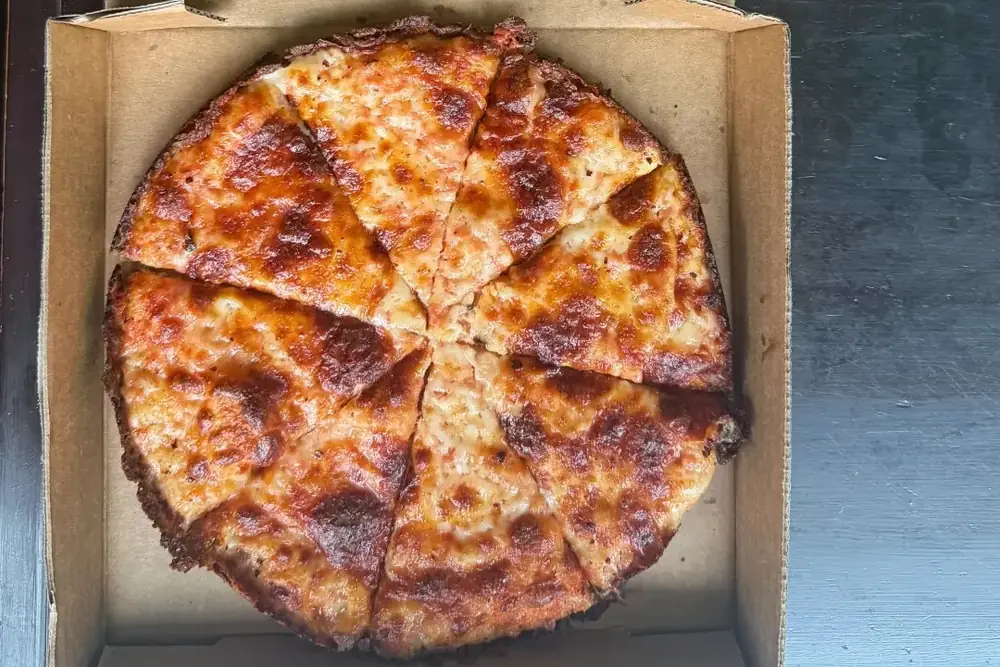
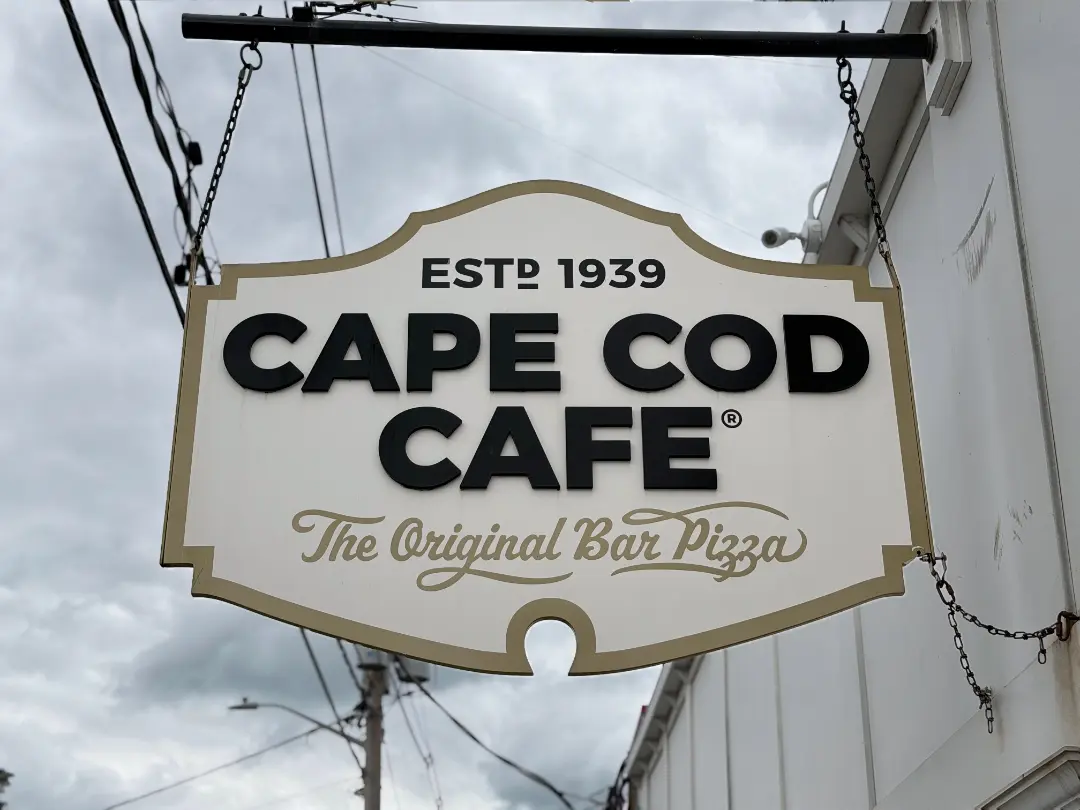
The style traces to Brockton, where the Cape Cod Café opened in 1939 and added pizza to the menu in 1947. The format is unmistakable: a thin crust baked in a seasoned steel pan, one pie to a person, cheddar in the blend. Everything runs to the rim, where it crisps and caramelizes against the metal. Ask for it laced or burnt, depending on which town you’re in, and that edge gets darker still.
Takeout comes in a brown paper bag, the pizza sandwiched between two paper plates and the bag cinched at the top.
People drive for it. They argue about it. They defend whichever place was closest to the house they grew up in, the same way they do north of Boston. And they’ll tell you plainly that you don’t find the real thing north of the Neponset River.
In 2025, state Sen. Michael Brady of Brockton filed S.2548, a bill to make bar pizza the official pizza of Massachusetts. A committee reported it favorably that November and sent it to the Senate Committee on Rules, where it has sat ever since. Formal sessions ended in July. Massachusetts still has no official pizza.
What would a South Shore sandwich even be?
The South Shore doesn't need a Beef. It needs a sandwich of its own, and the ingredients are lying around. Thanksgiving happened here first. Turkey, stuffing, and cranberry on a bulkie. The sandwich probably came out of the small turkey farms that dotted the coast after World War II, and one in Duxbury has been selling its version for decades. It just never became a South Shore thing.
Does James River make it over the bridge, or is that a North Shore sauce? Extra-heavy mayo, or is that ours too? White American or cheddar, since cheddar wins everything down there? And does linguiça go on it?
What do you call it?
We’d probably get it wrong anyway. It isn’t our sandwich to build.
The North Shore has its Beef. The South Shore has its bar pizza.
Now it’s your turn. Build us a South Shore sandwich. Tell us what goes on it.

Common questions about the North Shore and South Shore
Where are the North Shore and South Shore of Massachusetts?
The North Shore runs north of Boston, through communities including Salem, Gloucester, Rockport, and Newburyport. The South Shore heads south through Quincy, Hingham, Scituate, and Plymouth. Cape Cod begins beyond the Cape Cod Canal, and is generally considered a separate region. Short version: the North Shore is known for the Beef, the South Shore for bar pizza.
What’s the difference between Cape Ann and Cape Cod? Is Cape Cod on the South Shore?
Cape Ann is part of the North Shore; Cape Cod is a separate region beyond the Cape Cod Canal, not part of the South Shore. Geographically, Cape Ann generally refers to Gloucester, Rockport, Essex, and Manchester-by-the-Sea. On the Beef Country map, North Shore Beef Hub uses a broader eight-town Cape Ann region that also includes Hamilton, Ipswich, Topsfield, and Wenham. Travelers from Boston drive through the South Shore to reach Cape Cod.
What is Beef Country?
Beef Country is North Shore Beef Hub’s 66-town map of Beef shops across five regions north of Boston. More than 150 shops make Beefs there.
Is there a South Shore version of the North Shore roast beef sandwich?
Not really. The roast beef sandwich known locally as a Beef is a distinct regional tradition centered north of Boston. The South Shore’s equivalent is bar pizza: an individual, roughly 10-inch pizza baked in a seasoned pan, with a crisp bottom and cheese pushed to the edge. It isn’t a South Shore Beef. It’s an entirely different argument.
Is bar pizza the official pizza of Massachusetts?
No. State Sen. Michael Brady of Brockton filed a bill in 2025 to designate it. A committee reported the bill favorably that November and referred it to the Senate Committee on Rules, where it stayed. It never reached a vote, and formal sessions ended in July 2026. Massachusetts has no official pizza.